
Matching Mechanics at Work
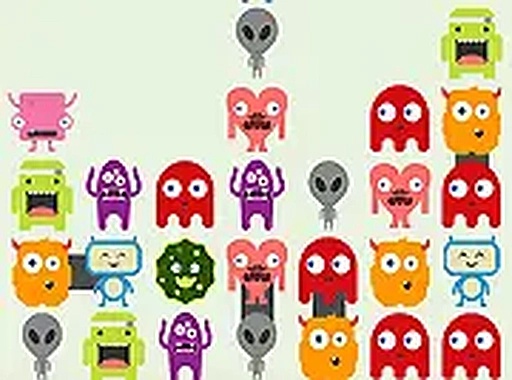
At its heart, this puzzle game asks players to identify and combine identical creatures on a grid. Dragging one creature onto its matching counterpart merges them into a single, larger form. This action frees up space on the board, allowing new pieces to appear. The process continues until the hidden dragon is fully assembled. Each merge requires careful observation, as the grid constantly shifts and fills. The core loop is simple to grasp but demands attention to detail as the game progresses.
Grid Management Strategy
Success depends on how well players manage the available space. Merging creatures in the lower sections of the grid often creates room for incoming pieces. The game introduces pressure through a move or time limit. When either runs out, an extra row of creatures appears, pushing everything closer to the edge. The session ends when the grid becomes completely blocked. This system encourages forward thinking and deliberate placement, turning each session into a test of spatial planning.
Visual Style and Accessibility
The creatures are designed with bright colors and friendly shapes, making the game suitable for younger players. The interface remains clean and uncluttered, with clear indicators for moves and remaining space. Full screen mode is available on both desktop and mobile browsers. Touch controls work smoothly on tablets and phones, while mouse input provides precise control on computers. No installation or account creation is required, so players can start a session instantly.
Progression and Challenge Curve
Early rounds introduce the basic merging concept with a generous time allowance. As players advance, the grid fills faster and the margin for error shrinks. The hidden dragon becomes visible in stages, providing a clear goal to work toward. While the game does not feature explicit levels, the increasing difficulty creates a natural progression. Players who enjoy classic arcade-style puzzles will find the gradual ramp satisfying. The challenge remains fair, relying on skill rather than random chance.
Comments
0 comments